Autonomous Micro-Factories take EV industry to the next level with AI
Microfactories building high-mix, low-volume products, including EV vehicles, were failing to scale because their operations ran on disconnected systems, manual processes, and reactive quality and maintenance practices. I led UX design for the Horizons project, an end-to-end connected operations experience spanning warehouse receipt through final dispatch, orchestrated by AI across five distinct roles. The result was a comprehensive experience architecture and device ecosystem that demonstrated a clear path from fragmented status quo to real-time, AI-assisted production operations.
Client
Type
Year

Approach
The company delivers enterprise hardware and software solutions for industrial and logistics environments. Horizons was a strategic initiative to design and demonstrate what a fully orchestrated, AI-enabled microfactory could look like end to end, with EV manufacturing as the primary target.
I was the lead UX designer, operating without a dedicated design team and working cross-functionally with product strategy, engineering, and go-to-market stakeholders. I owned the full experience scope: problem framing, persona development, service blueprint, device-experience pairing, and the iterative prototype framework used for executive and customer demonstrations. Key constraints included high-fidelity timeline pressure and a genuinely complex multi-device ecosystem spanning wearables, HUD displays, kiosks, tablets, AMRs, and edge computing hubs. Every design decision had to be grounded in what the hardware could actually sense, compute, and communicate in real time.
The Problem
Five interconnected failures compounded each other across the factory floor. Manual, paper-based processes created choke points and high error rates with no feedback loop. Siloed systems meant data never reached the right people in time, causing cascading delays and production holds. Reactive quality management caught defects too late, with quality failures estimated at 15–20% of total product cost. Reactive maintenance addressed machine failures after they occurred. And with no orchestration layer tying any of this together, there was no mechanism for agentic AI to act on what sensors were already seeing.
The risk wasn't just operational inefficiency, it was that microfactories could not achieve their core promise: flexibility and scalability at low volume without proportional complexity growth.
Approach
I defined success as meaningful reduction in unplanned exceptions, the moments when a worker has to stop, diagnose, escalate, and wait. Rather than redesigning underlying enterprise systems like WMS or MES, I focused on the orchestration and exception-handling layer, the connective tissue between systems, people, and devices.
The strategic bet was to design for AI-assisted human judgment, not full automation. Workers adopt systems more readily when AI gives them confidence rather than removing their agency. Agentic AI handles routing, tracking, and low-level decisions in the background; humans handle ambiguity.
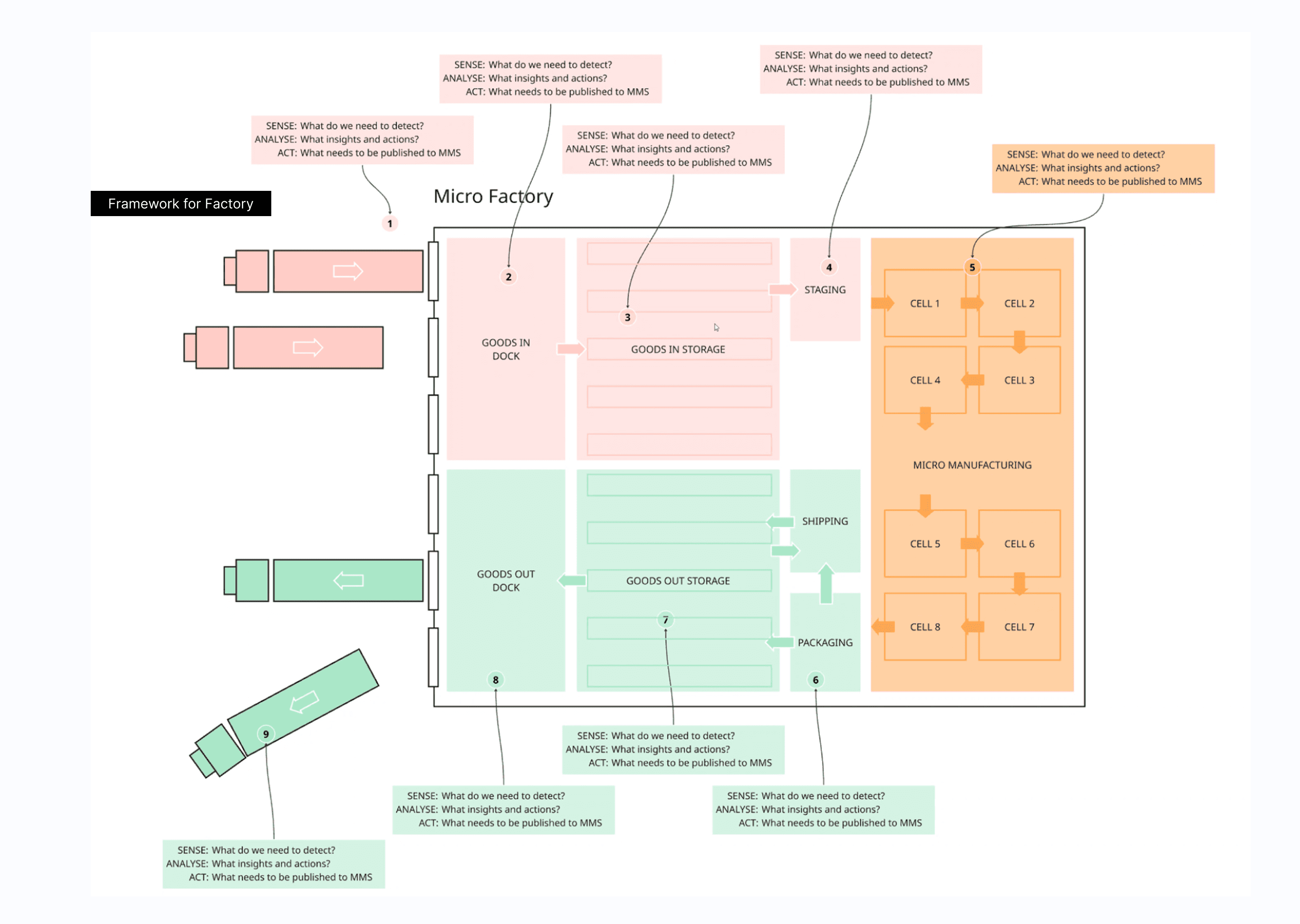
To align stakeholders, I structured the experience as six immersive pods, each representing a node in the production journey. This gave every team a concrete entry point and made the abstract vision testable and demonstrable.
Process
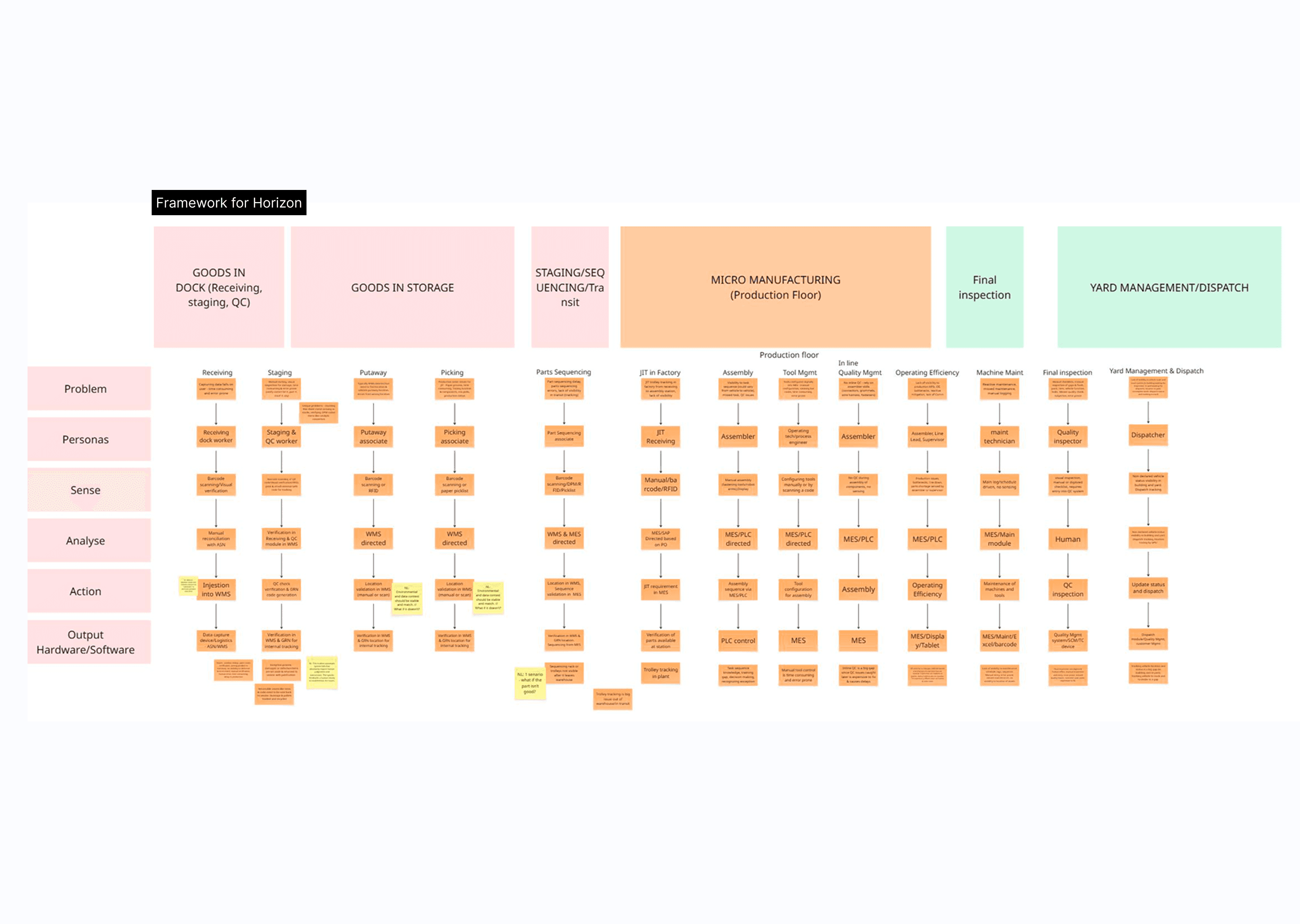
Problem framing through synthesis revealed that the biggest pain was never any single broken system, it was the absence of cross-system coordination. I mapped six problem categories across the full production flow, and that framing shaped every design decision that followed.
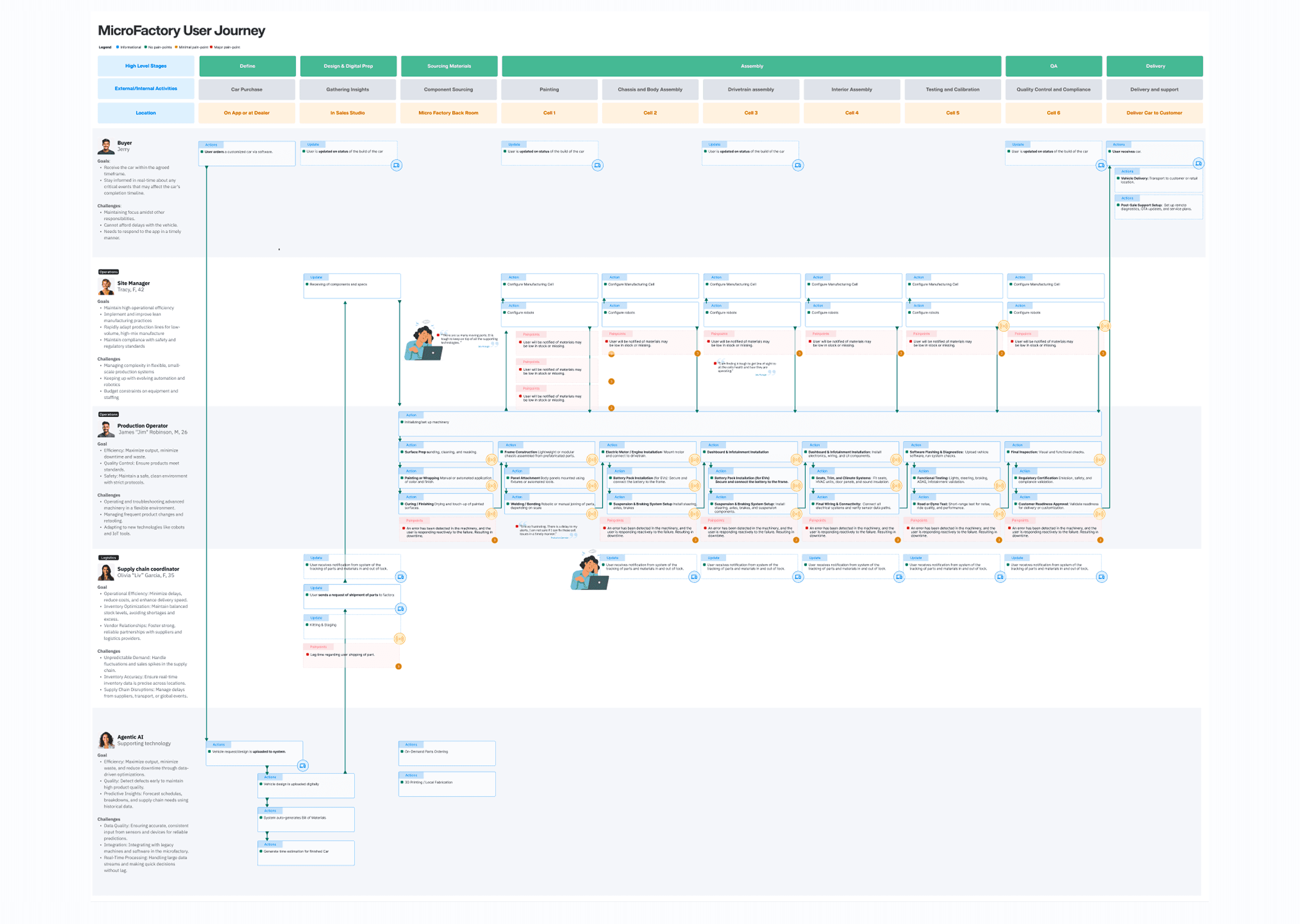
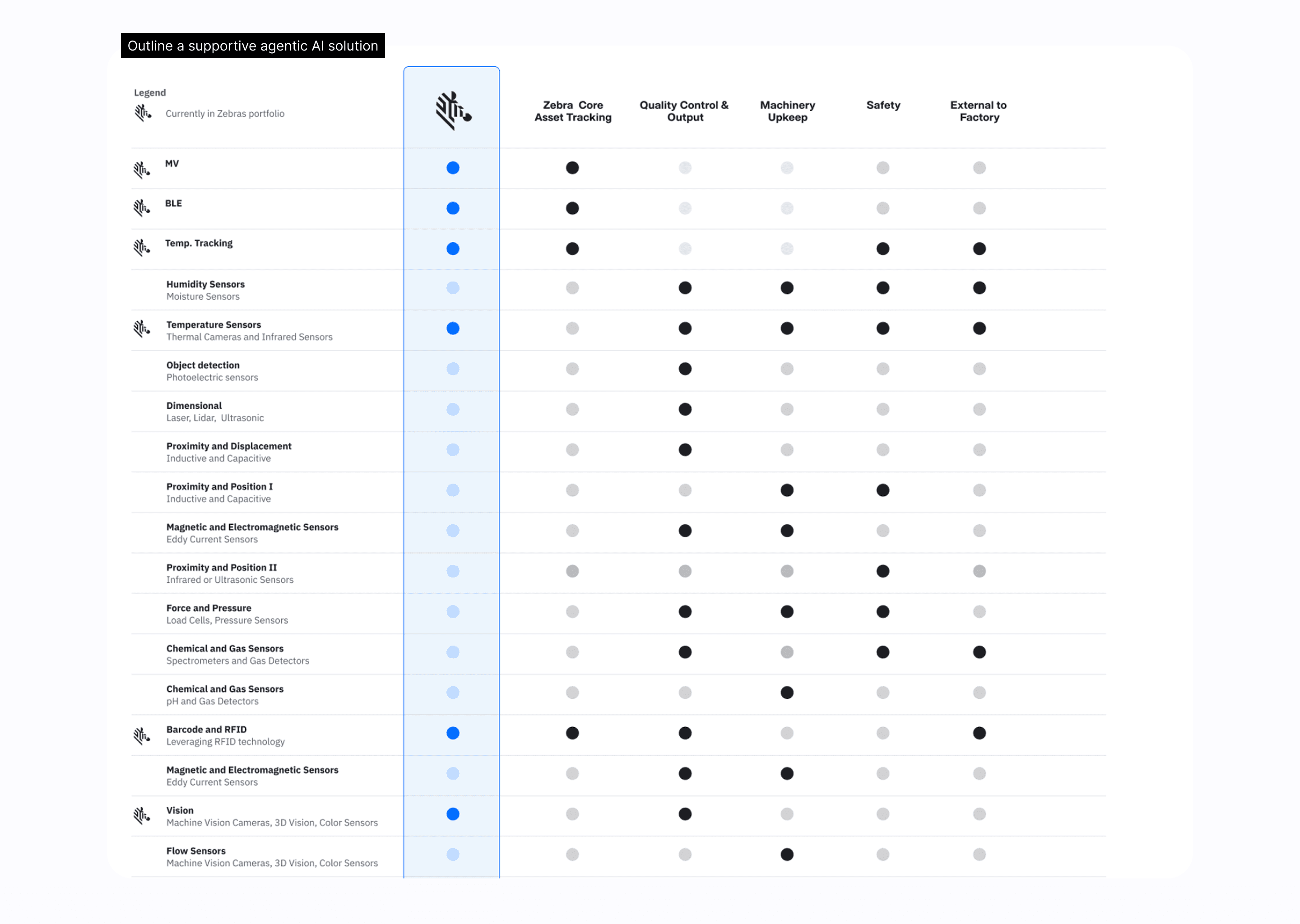
A cross-functional service blueprint became the primary alignment artifact, spanning six production stages and mapping problems, personas, sense/analyse/action layers, and output hardware at each stage. It also served as a dependency map, exposing where edge computing, connectivity, and device form factors created real constraints.
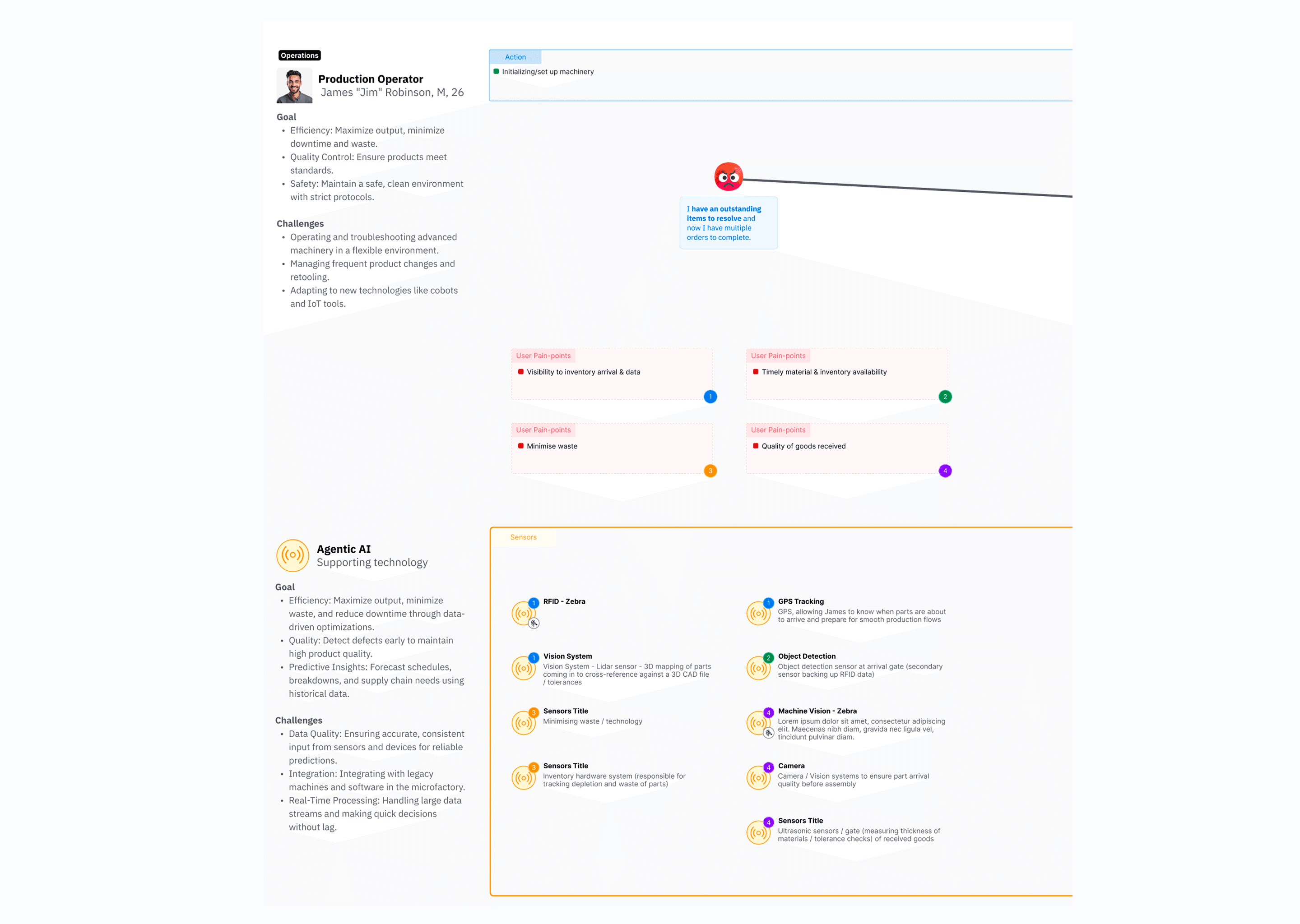
Device-persona pairing was a critical decision at every stage. A production supervisor monitoring KPIs needed a tablet with ANDON dashboards. An assembler in a noisy cell needed voice guidance via wearable, not a screen. A maintenance technician diagnosing a live fault needed HUD control and a prescriptive workflow. These decisions were grounded in cognitive load, matching the right interface to the context rather than applying a single UI across every situation.
A key reframe midway through the project also mattered. The initial pod layout organized the experience around the physical supply chain sequence. A reframed version restructured the pods around platform capabilities: scalability, holistic orchestration, connected device and AI data capture, multi-agent workflows, and ambient intelligence. Executive stakeholders understood platform strategy, not factory floor sequencing, and the same content landed completely differently.
Solution
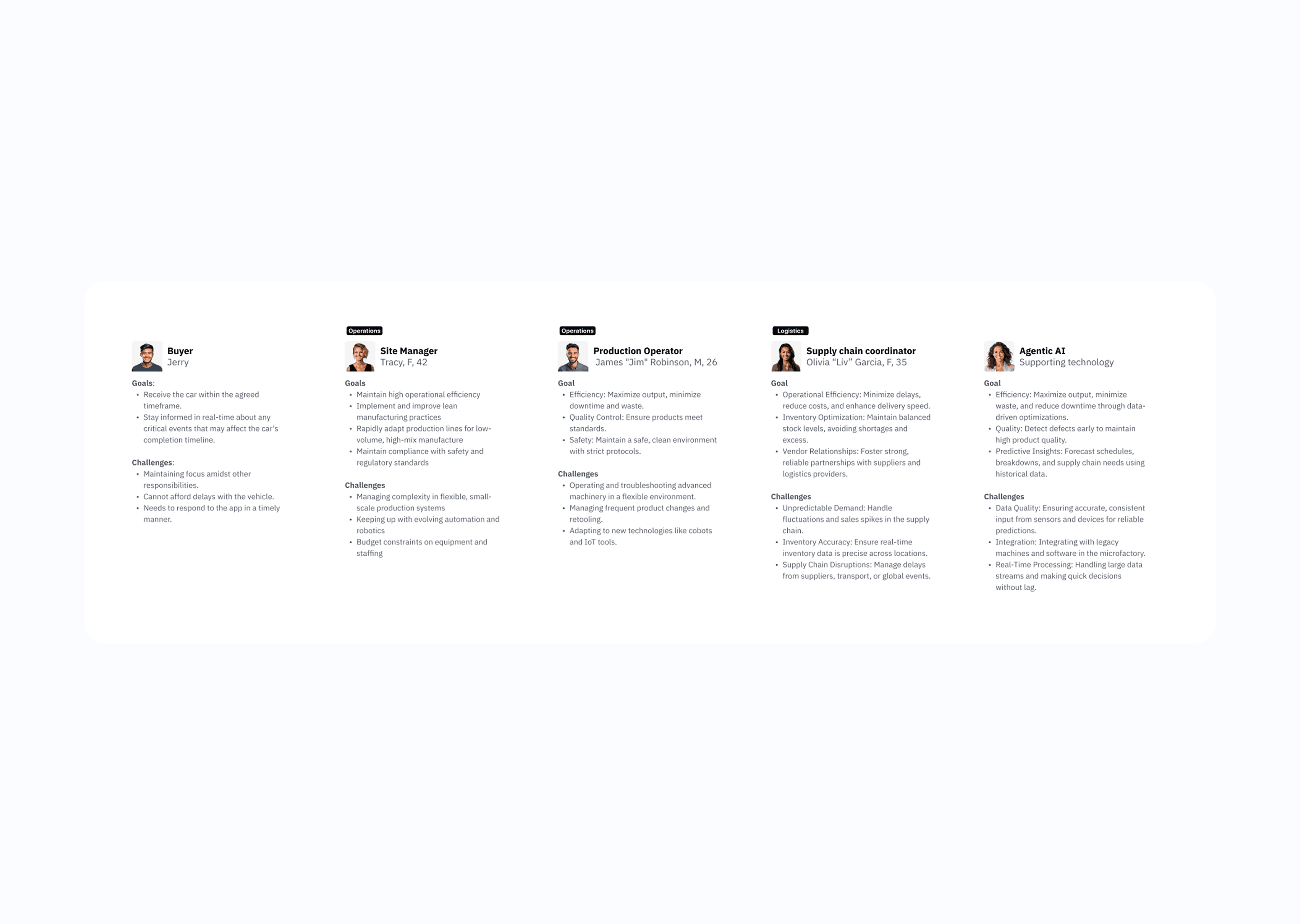
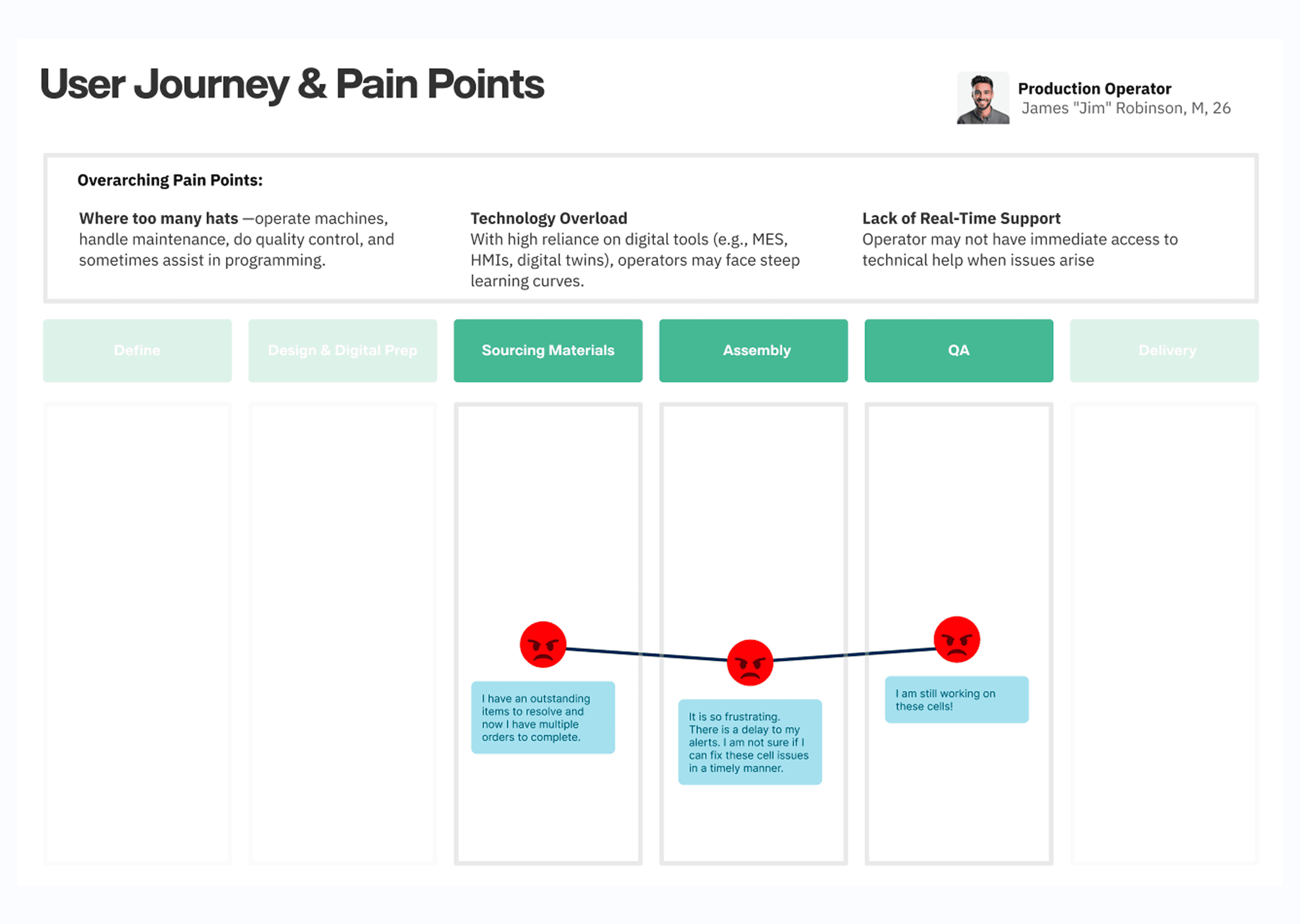
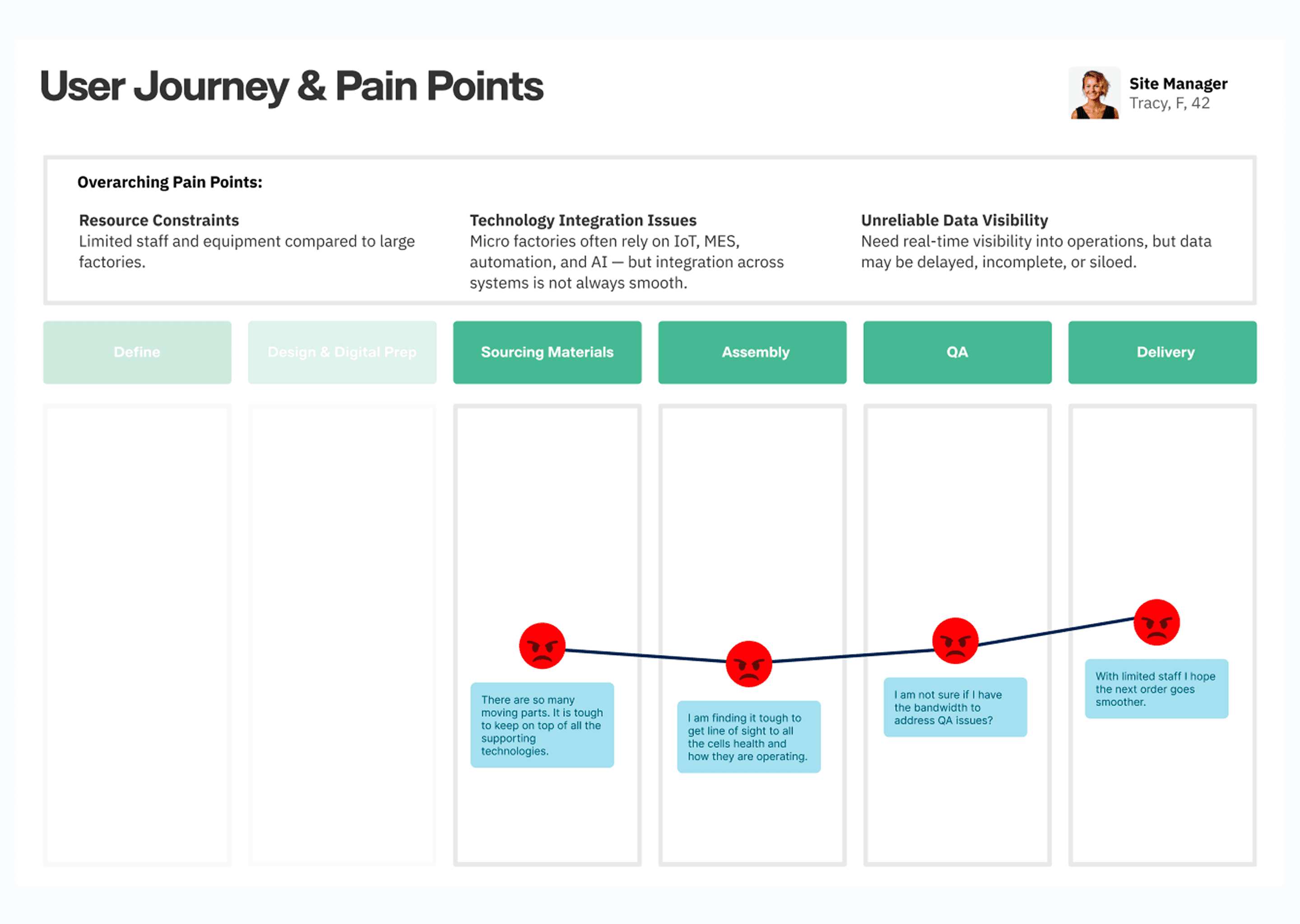
The core deliverable was a connected experience architecture linking five roles, site manager, production operator, supply chain coordinator, agentic AI, and buyer, across six operational contexts.
The highest-impact flow was Cellular Assembly and Inline Quality Management. In a live EV manufacturing cell, an AI-enabled robot installs the battery while a human installs the wiring harness. The worker receives voice-guided step-by-step instructions through a chest-mounted wearable while machine vision monitors every assembly step. If an anomaly is detected, corrective feedback is delivered to the wearable immediately, without supervisor intervention. CAPA is triggered in real time, not at end-of-line inspection. The supervisor's ANDON dashboard reflects production KPIs by cell without requiring physical presence.
Running in parallel, Prescriptive Maintenance used IIoT audio and vibration sensors to detect a failing adhesive dispensing system before failure. Agentic AI notified the maintenance technician with a prescriptive workflow on their foldable device, including HUD-controlled machine shutdown if required. No line-down event, no unplanned disruption.
Upstream, the Connected Warehouse and Logistics experience provided real-time tracking from order update through truck receipt at the dock, with passive RFID and camera vision eliminating manual logging at every handoff.
Impact
Shifting from reactive, post-process QMS to inline AI detection directly targeted the 15–20% quality-related cost overhead. Prescriptive maintenance workflows reduced unplanned downtime risk across cellular production. Real-time tracking across RFID, camera vision, and geotags eliminated the manual logging burden and the blind spots it created.
The six-pod experiential framework was adopted as the go-to-market demonstration format for Horizons, used in executive and enterprise customer engagements. The reframed pod structure, organized around platform capabilities rather than factory floor sequence, consistently landed more clearly with executive stakeholders, a signal that the design framework itself was doing strategic communication work, not just product demonstration.
Reflection
The most important design decisions on this project had nothing to do with screens. They were about when AI output surfaces to a human, which human, through which device, and with what level of detail. Designing for an AI-augmented worker is a fundamentally different discipline than designing for automation, and the distinction matters enormously for adoption and trust.
If I could do this again, I would invest time earlier in mapping sensory and technical constraints per device form factor, particularly around edge computing latency and connectivity gaps. Several experience flows assumed data availability that engineering later flagged as dependent on variable network conditions in real factory environments.
This work also clarified a broader design principle: in ambient intelligence environments, the most critical UX question is not what the system can do, but what it should interrupt. Getting that threshold wrong in either direction, too many alerts or too few, determines whether workers trust the system or route around it.
The Horizons project shaped how I think about multi-agent UX, ambient sensing, and cross-device orchestration as core disciplines for industrial experience design, not edge cases.